Although email marketing is effective, it is becoming increasingly expensive.
Scaling becomes more difficult over time because most SaaS tools continue to raise prices as your email list expands.
More businesses are now adopting self-hosted email marketing tools to reduce costs and gain greater control over their infrastructure.
What does self-hosting actually mean, then?
It gives you complete control over your data, expenses, and infrastructure because you install and run the software on your own server (or cloud VPS).
Instead of relying on a third-party platform, businesses manage the system themselves.
Cost reduction is only one reason businesses are shifting toward self-hosted platforms. Businesses also gain greater flexibility and long-term scalability without rapidly increasing platform costs.
In this guide, you’ll discover the best self-hosted email marketing tools that can help you scale faster while keeping costs low.
Why Choose Self-Hosted Email Marketing Software?
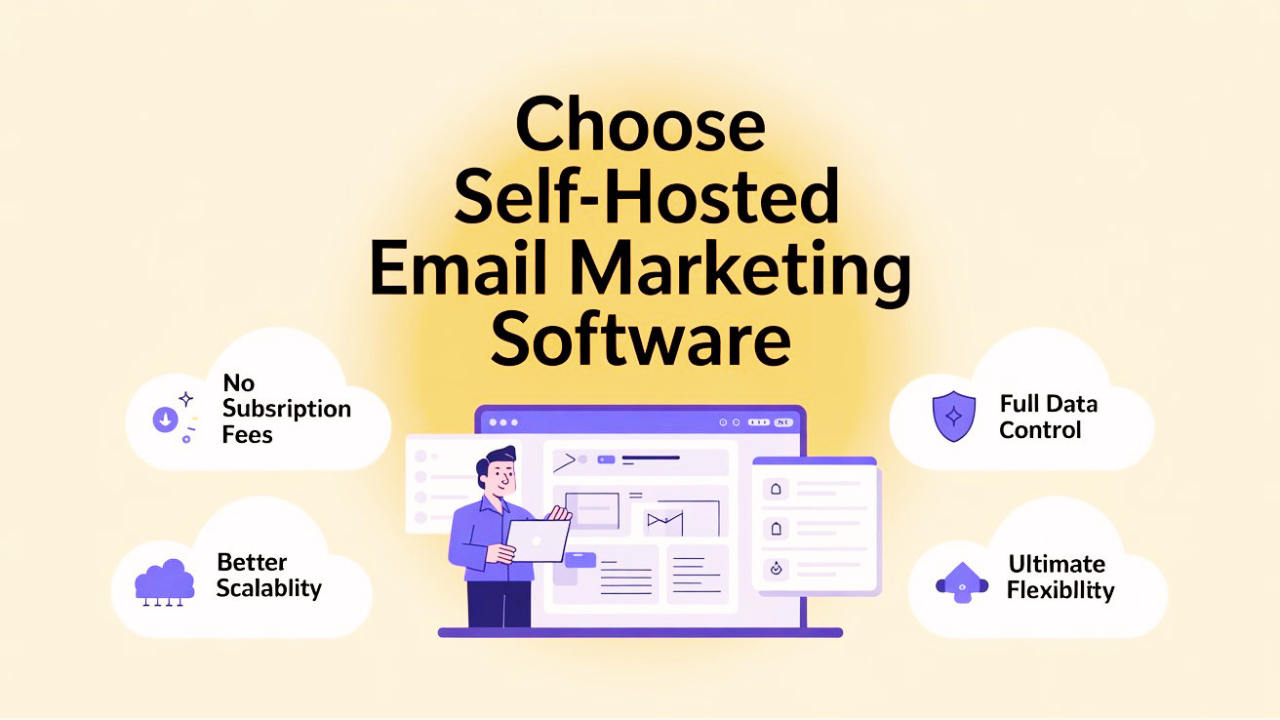
1. No Recurring Subscription Fees
With most self-hosted tools, you don’t pay again and again. Your main costs are:
- Server hosting
- Email sending (using services like SMTP providers)
The best part? Your software cost remains constant as your list grows, whether you have 1,000 or 1,000,000 subscribers.
2. Full Control Over Your Data
Your data stays on your own server, not on someone else’s platform. This means:
- Better privacy and security
- Easier compliance with rules like GDPR and CCPA
- Full control for agencies managing client data
3. Better Scalability
Your contacts and campaigns live on your own server, not on a third-party platform. This gives you better privacy, security, and peace of mind.
No sudden price jumps, just smooth growth.
4. Ultimate Flexibility
Developers can customize the code, create custom integrations, and connect to their own CRMs. Some tools (like Sendster) also include advanced features such as:
- SMTP rotation
- Content spinning
- Built-in AI tools
Key Features to Look for in Self-Hosted Email Marketing Software
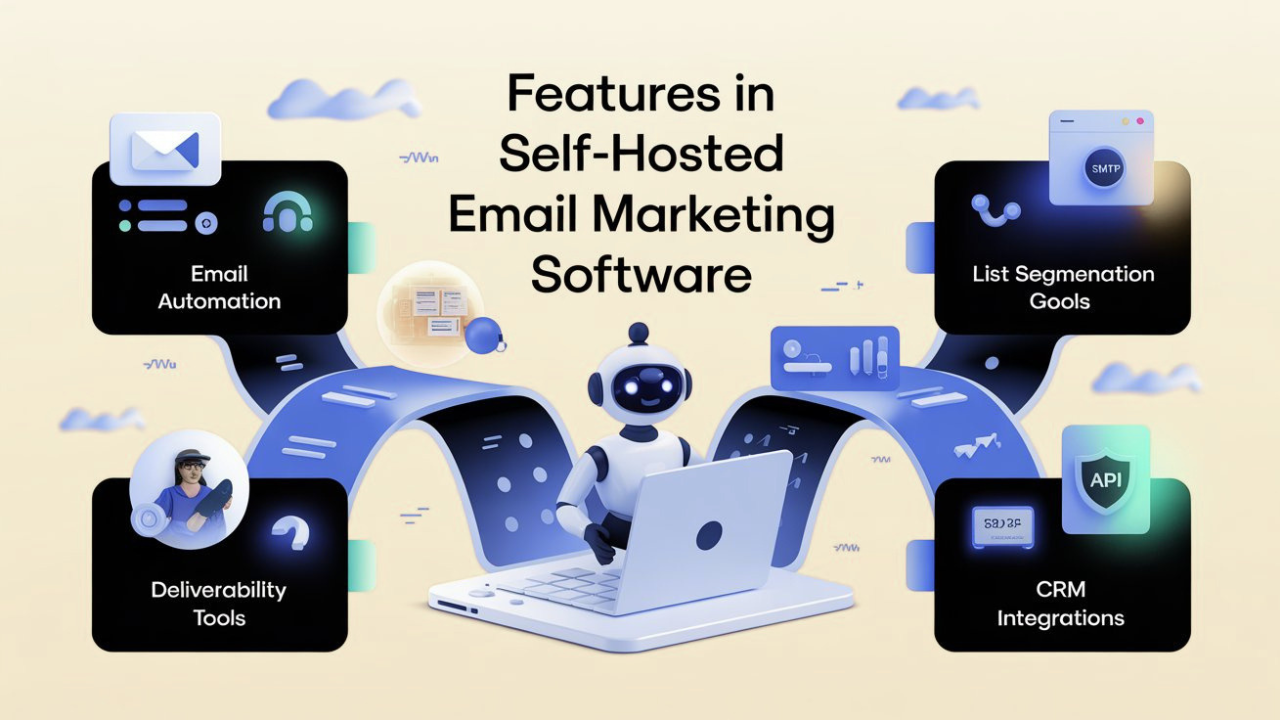
Not all self-hosted email tools are created equal. Here are the features that should guide your
Evaluation:
A. Email automation and workflows
A good tool should let you send emails automatically based on actions, time, or tags.
Whether it’s a welcome series or a drip campaign, the process should feel simple and easy to manage, not technical or confusing.
B. List management and segmentation
You should be able to organize your subscribers effectively.
This means grouping people based on their behavior, interests, or activity. When your list is well-segmented, your emails feel more relevant and that usually leads to better results.
C. Deliverability tools
Sending emails is one thing; getting them into the inbox is what matters. Support for multiple SMTP providers, SMTP rotation, SPF/DKIM/DMARC configuration, and bounce handling are all necessary for inbox placement.
That's why tools such as Sendster are built with this focus, helping improve delivery rates while also offering automation and content features.
D. CRM and app integrations
Your email tool should fit into your existing workflow. Whether it’s connecting with a CRM, using webhooks, or tools like Zapier, smooth integration saves time and keeps everything connected.
7 Self-Hosted Email Marketing Software Lists That Save Cost
1. Sendster - Best Overall Pick for Cost Savings + Al Power
Overview

Sendster is a cutting-edge self-hosted email marketing platform that prioritizes simplicity and effectiveness. It combines analytics, campaign management, and automation into an easy-to-use interface.
Pros
⬆️ Easy to set up, even for beginners
⬆️ Built-in automation tools
⬆️ Affordable as your list grows
⬆️ Clean and simple user interface
Cons
⬇️ Smaller ecosystem than open-source tools
⬇️ Requires hosting setup
Ideal For: Beginners getting started with self-hosting and marketers who want a simple, controlled setup without too much complexity.
2. Mautic - The Open-Source Marketing Automation Powerhouse
Overview

With only one open-source installation, Mautic manages email marketing, landing pages, lead nurturing, website tracking, social media monitoring, SMS, and more.
Not just an email sender, it is a full marketing automation suite that rivals paid platforms like HubSpot and Marketo in terms of functionality.
Pros
⬆️ Powerful and advanced automation workflows
⬆️ Strong support from an active community
⬆️ It can be highly customizable.
Cons
⬇️ Not beginner-friendly
⬇️ Needs a dedicated VPS (won’t run well on shared hosting)
Ideal For: Marketing teams and tech-savvy users who want full control and advanced automation without paying for expensive software.
3. Sendy — Budget-Friendly Email Marketing with Amazon SES
Overview

One of the most well-liked self-hosted tools for marketers looking to cut expenses is Sendy.
Amazon SES, which manages email sending at a very low cost, is connected to your own server (PHP/MySQL). This approach can save you a substantial sum each month when compared.
Pros
⬆️ Very low cost for sending emails
⬆️ Simple and quick to use
⬆️ Supports white-label accounts for clients
Cons
⬇️ Requires Amazon SES to work
⬇️ No drag-and-drop email builder
⬇️ Customer support can be slow
Ideal For: Businesses or marketers who send large volumes of emails and want to keep costs as low as possible while being okay with a basic setup.
4. MailWizz — Control Over Your Email Infrastructure
Overview

This platform offers a SaaS-like experience while running on your own server, giving you both control and convenience with MailWizz. It combines ease of use with advanced features, making it a well-rounded choice for managing email campaigns.
Pros
⬆️ Modern and clean interface
⬆️ Feature-rich and scalable
⬆️ Built-in multi-client (agency) support
⬆️ Active development + extensions marketplace
Cons
⬇️ Higher upfront cost than basic tools like Sendy
⬇️ Requires VPS/cloud hosting (not ideal for shared hosting)
Ideal For: Agencies, ESPs, and businesses that want a powerful, client-ready platform with a one-time license.
5. Postal - Control Over Your Email Infrastructure
Overview

By enabling you to manage your own mail server, "Postal" goes above and beyond standard email marketing tools.
It gives you full control over how emails are sent, whether for transactional messages or bulk campaigns, without depending on external SMTP services.
Pros
⬆️ Full control of sending infrastructure
⬆️ No dependency on external SMTP providers
⬆️ Detailed logs and monitoring
Cons
⬇️ Requires technical knowledge to set up and manage
⬇️ You need to handle IP reputation yourself
⬇️ Not a campaign builder (needs to be paired with another tool)
Ideal For: SaaS companies, hosting providers, and tech teams that want complete control over email delivery.
6. NuevoMailer—Feature-Rich Platform
Overview

A mature self-hosted email tool that offers advanced features with a one-time license. It supports multiple sender profiles, making it easy to manage different brands from one place. It also includes optional AI features to help with content creation inside the platform.
Pros
⬆️ Advanced conditional content targeting
⬆️ Multi-brand support with sender profiles
⬆️ Date-triggered campaigns
⬆️ Built-in AI content assistance (optional)
Cons
⬇️ Interface feels slightly outdated
⬇️ Smaller community compared to tools like Mautic
Ideal For: Businesses that need advanced personalization, multi-brand management, and automated date-based campaigns.
7. Mailcow — Docker-Based Full Mail Server Suite
Overview

A complete email server solution that combines key tools into one system, giving you full control over your email setup.
It comes with a clean web dashboard, making management easier even without great technical skills, and it works well as a self-hosted alternative to major email services.
Pros
⬆️ Complete email server in one platform
⬆️ Built-in DKIM, DMARC, and SPF
⬆️ Docker-based for easy deployment and updates
Cons
⬇️ Not a marketing/campaign tool by itself
⬇️ Requires IP reputation management
⬇️ Needs basic Docker knowledge
Ideal For: Businesses and IT teams that want full control over their email infrastructure, best used alongside a campaign tool for marketing.
Pick the Best Self Hosted Email Tool for Your Needs
Choosing the right self-hosted email tool depends on your setup, technical skills, and scale.
A. For WordPress Users
If you’re already using WordPress, tools like Sendster or FluentCRM are easy to get started with.
- Sendster runs on shared hosting (even alongside your WP site)
- FluentCRM works directly inside WordPress
Both options keep your data in-house without requiring a separate infrastructure.
B. For Developers & Scalability
If you need more control and performance, tools like Mailtrain or Keila are better choices, and they are built for scalability and offer:
- API-first architecture
- Docker support
- High-performance bulk sending
C. For Enterprise & Full Infrastructure Control
If your goal is complete control over your email system, tools like Postal or Mailcow are worth considering. Postal focuses on SMTP infrastructure, while Mailcow provides a full mail server setup.
Conclusion
Email marketing costs often increase as businesses scale, especially with traditional SaaS platforms.
More businesses are adopting self-hosted solutions to gain greater cost control and long-term flexibility. Self-hosted systems reduce the constant pricing increases tied to subscriber growth. Businesses also retain control over their data and infrastructure while scaling campaigns more predictably.
If you want a simple and modern setup, tools like Sendster offer a good balance of ease and functionality. Pairing it with a service like Amazon SES can give you a reliable, professional email system.
In the end, self-hosting takes a bit of effort at the start, but the long-term benefits are clear, lower costs, more control, and freedom from platform limits.
Businesses facing rising email platform costs may benefit from evaluating self-hosted alternatives.
Frequently Asked Questions (FAQs) About Self-Hosted Email Marketing Software
Q1: Do I need a developer to set up self-hosted software?
A: Not all tools, such as Sendster and Sendy, are suitable for novices. If you can handle basic setups like WordPress, you can usually get started without a developer.
Q2: Is the setup complicated?
A: Not really. Most tools can be set up in around 30 minutes on a basic VPS if you follow simple steps.
Q3: What is the difference between self-hosted and open-source tools?
A: Self-hosted means you run the software on your own server. Open-source means the code is publicly available, so you can modify it.
Some tools offer both (like Mautic or Postal), while others are self-hosted but don’t provide open-source access.
Q: Will my emails go to spam?
A: That mostly depends on your SMTP provider and your sender reputation, not the software itself. Using reliable services and proper setup plays a big role in inbox delivery.